Showing posts with label law school. Show all posts

Thursday, 31 May 2012

Utrecht and architecture


I sometimes have the feeling that I am too negative about the university. It is just in a Dutchman’s nature to complain about everything. The great things about Utrecht University are eventually taken for granted, which is not a good thing for a blogger like me who is out to give international students a fair look at their possible destination.

Obviously there are many great things I could talk about, but I want to focus on Utrecht’s architecture. Utrecht is situated in the middle of the Netherlands, but it has the Rhine flowing through it. A lot of the buildings next to the river have a lower level just above the water and a main floor where there is no risk of flooding if the water rises.


The Wikipedia page for Utrecht has a lot of pictures and background for those interested. The buildings all look very authentic and most university buildings inside the city center are just renovated on the inside to accommodate a great number of students. One building, Achter Sint Pieter 200, used to be a very big bank and still holds many authentic details while being a very modern building once you get inside.


Inside the city are five churches, which form a Christian cross if conntected on a map. In the center is the Dom, a huge cathedral, with gorgeous details. I believe you are allowed to climb to the top for only a few euros, which is well worth it if you are not too afraid of hights.
What I find really amazing though, is that Utrecht University also has very modern and strange architecture. The university campus, called the Uithof, is just outside of the city, about 20 minutes by bus from the city center. All the university buildings not in the city center are built there and they all look incredibly modern and amazing. The Educatorium, containing two enormous lecture halls, three examination rooms and the biggest cafeteria I have ever seen. It has a slope down for the cafeteria and one up for the lecture rooms. On the right side of the slope is glass so you can look outside, where there is also a slope and several geographical figures decorating the building.
 
 The library, containing more than four million books spread over several floors, looks very modern and is very comfortable to be in. It does not only contain legal texts, but it is shared instead with all departments. If you are anything like me and you regularly feel like branching your research, this library is a gift sent from heaven.


The Minnaert building has a fountain inside of it, which provides a green way of cooling the building. Also, how awesome is to have a fountain greet you between classes? This is a physics building though, so you probably will not spend much time in it. Not that the university minds if you peek inside. If you really get in trouble, say you are doing a case study on laws pertaining to construction provisions.


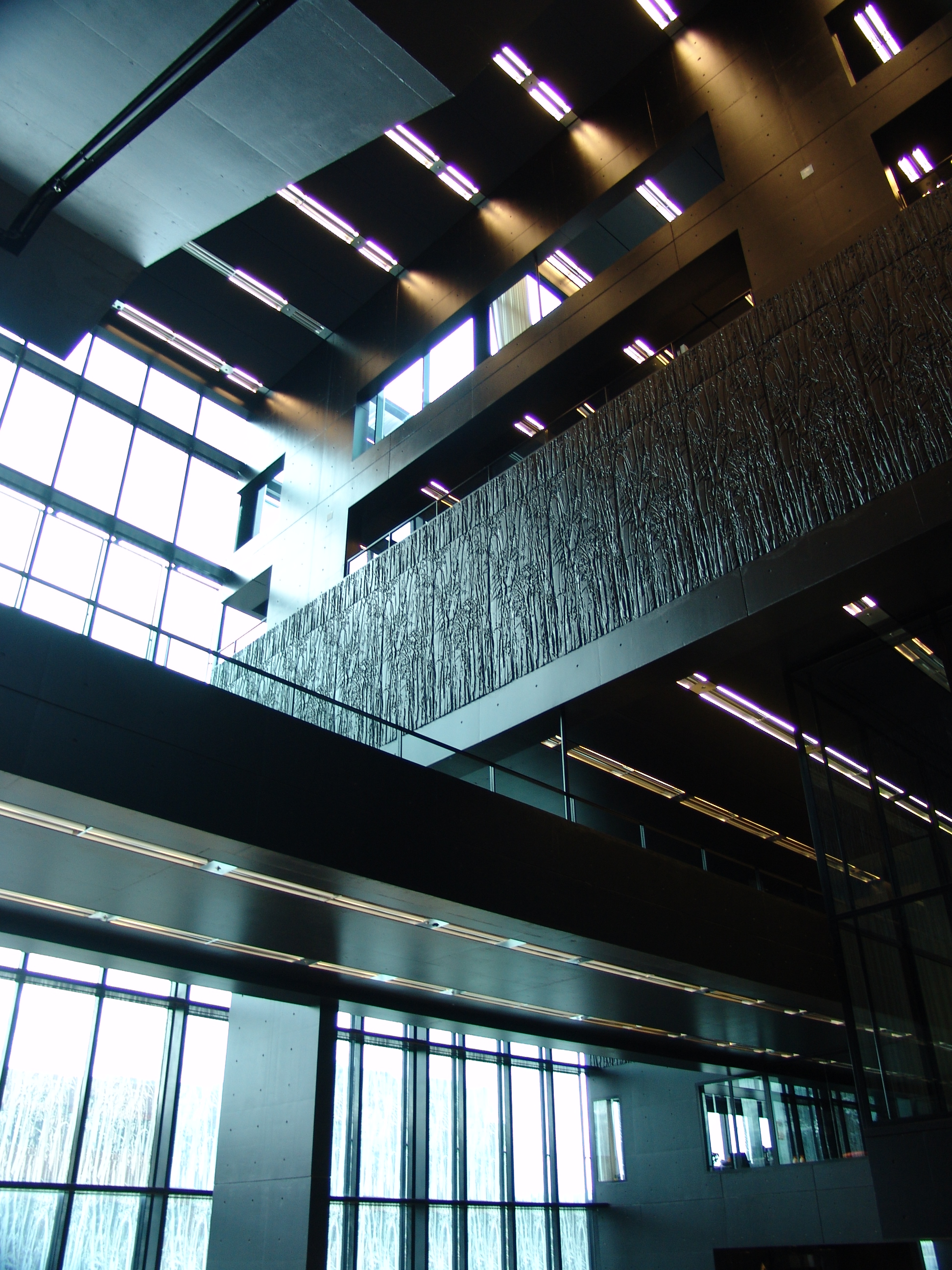
In short, Utrecht looks awesome. Even if you do not decide to study there, it is well worth it to visit it at least once in your life.

Monday, 14 May 2012

Doing the research


It is always a strange sensation when you are required to research your material. Coming from a background in exact science, I expect research to entail the scientific process and to contain actual experiments. For law, however, most research comes from reading texts that others have written; either a lawmaker who makes the rules or a judge or professor who interprets them.

For my master thesis, I need to do three kinds of research. The first is research into literature and has to do with the principle of legality (focusing on lex certa). Since this is such a famous principle, I can easily find a lot about it from just the handbooks I have available to me already. The handbook by De Hullu, for instance, includes pages and pages of discussion on the principle. Other works are referenced and one needs to double check the logic used, but it still feels like a massive appeal to authority some of the time.

The second type of research is done regarding a new law. I need to get familiar with the new provisions, read the Memorandum of law to understand the intentions and finally read the written transcripts of the lawmaker’s discussions. This is hugely illuminating and I really feel like I am getting useful data about the material… sometimes. Other times I feel like I am just summarizing.

The final type of research is done by comparing specific provisions with other provisions. Since I am talking about a provision that summons a general responsibility for the well-being of animals, it becomes very useful to compare that with the provisions that summon a general responsibility for the well-being of the environment, or for the soil. I have never actually done this before, so I will be a little unclear about its details until I do it for my thesis.

There are other kinds of research, obviously, some even requiring the researcher to look up actual scientific work like Biology or Chemistry. I did this about twice in my four-year study, both times with far less rigor than I would expect to be needed, both times with far more praise than I had anticipated. There are also research methods where you analyse cultures from the past or compare with the provisions of other countries.

All these methods have in common that they are pretty far removed from fully objective research. This bothers me at times, except when I realise there really are not many alternatives when dealing with law. If I wanted an exact science, I should have studied Physics instead. Or Chemistry. Or Biology. Or… basically any other study that actually studies the world instead of an arbitrary system of human-made rules.

Monday, 7 May 2012

Being graded


I have always had a weird relationship with being graded. I hate failing, I love high grades, but I have never truly been able to predict whether I will get a high grade or a low grade. You would think that means I am incredibly nervous when receiving grades, but the opposite is true. Just last week I got a grade which I did not bother to check until a few days had gone by first. Not because I was nervous; I had simply forgotten the grade was published that week.

Basically, I already knew I had a passing grade, just not what kind of passing grade. I can be incredibly confident when it comes to written assignments, maybe more so than I should be. In this case I had received a score of 60%, made into 67% because the whole class had difficulty with the exam. I finished the course with 74% average and I am pretty pleased with the result.

On the other hand, I can never be pleased with the results of individual assessment. That is, when I write a paper and I get anything less than full points I am inclined to argue and fuss. I also get extremely nervous and anxious when receiving the results, because there are far fewer excuses to hide behind if there is negative feedback. It sounds really silly when writing it down like this, but it is still true.

Like mentioned before, I suffer from a pretty bad case of imposter syndrome. No matter what I am doing, I get the sense that if I make the tiniest slip up, people will figure out I have no idea what I am doing and strip me of my bachelor’s degree (and, in a few months, of my master’s degree). Rationally, I know that this is their problem and not mine. If people were really going to critique, for instance, my spelling by saying it is so abysmal that I should have been kicked out of this university on the first day, then it is not my spelling that is the problem but their inability to properly value the properties required of a student. Had my spelling truly been that important, I would indeed have been kicked out sooner.

It sounds a bit Zen, but the important part is your own sense of accomplishment, the way that you value yourself, not some grade that has been given to you by some other person. And yes, I say that fully knowing that I would have been elatedly rubbing my grade in your faces if it had been over 80%.

Tuesday, 24 April 2012

Being prepared


Last Friday I talked about my master thesis. During the weekend I got an email from my professor advisor to set up a time for the first meeting. I have been fretting ever since about what I should and should not do to prepare for this talk. In two previous blogs I mentioned that it is impossible to be completely prepared for anything, and I wanted to expand on this.

My first year there was a course called introduction to Criminal Law. It was incredibly fascinating and I seemed to have an above average understanding of the material. I summarized the major points and posted the summaries online via the university website and got loads of compliments on how I had helped people pass that course. Meanwhile… I failed with an average grade of just under the minimum of a 5.5 out of 10. It took me a while to figure out what I had done wrong.

Partially it was because I was not used to answering questions in as much detail as was required, but it also had to do with me preparing in a different way. Coming from a background in exact sciences, I had always needed to learn how formulas worked. I had never needed to memorize them. Likewise, I was far more interested in learning how to use particular criminal provision to judge whether a particular behavior is criminal or not, rather than memorizing the names of the four different reasons we punish criminals.

My problem was that I had been prepared to understand the problems without preparing how to quickly and accurately solve them. Even then there is always more to learn and more to do. You can put stickers in your law books to more easily find specific provisions. You can write the names of jurisprudence by the articles and the articles by the jurisprudence. You can memorize summaries of the material and of the jurisprudence, or just memorize the literature itself. But when you get to that stage, where all the information is readily available in your head, you start thinking critically about some of the things you are being taught and, probably out of curiosity, start reading the quoted sources in the literature or reviews of the literature. You might look up other handbooks and start comparing the different points of view. Having an endless amount of time on your hands, you could become more knowledgeable than the professor testing you.

You have to draw the line somewhere. Students do not have an endless amount of time and are allowed to spend time on other things than studying. That may sound like an excuse, but it is the simple truth. A line has to be drawn somewhere and every student gets to decide for themselves where to draw it. As long as they are willing to live with the results, of course.

Friday, 20 April 2012

Master thesis


It has taken me over three and a half years to get here, but I am finally working on my Master thesis. It is weird, because the past years professors and students have told me constantly to prepare for this time. Whenever an interesting subject came up, I was supposed to jot it down so picking a subject would be easier.

It was still hell. A lot of subjects have already been discussed endlessly and specific problems have been discussed to little for a student to say very interesting things about. After thinking about it a lot, I remembered the introduction of a new law that had seemed significant to me at the time: a new law that in a sense introduces animal rights. I could write about how that would alter criminal law.

Except… that is far too vague and practically impossible to investigate exhaustively. After a quick talk with a professor, it turned out I should focus on a few specific aspects, like the legality. That made me also focus on a general provision that unclearly defines a general responsibility to care for all animals. Now that I have started talking with my Professor-Advisor, I have found that I need to focus more on this general responsibility. At the moment I have to change, based on his comments, the introduction and planning I had made. I am having a little bit of trouble with it at the moment because… well, if I knew exactly why I was having trouble with it, I would have already fixed the problem.

The thing is, nobody has ever taught me how to research and write a full thesis. I had some practice with the Bachelor thesis, but that was hardly filled with instructions and not all of the skills are fully transferable. But the more I am planning this massive body of text, the more I am able to cut it up in pieces that I am experienced in writing. I want to know about what kind of behavior becomes criminal according to a certain provision? No idea how to do that. Figuring out whether certain behavior X is criminal… that is Law School 101. So, simply generating a different amount behaviors is the difference between unable to answer a question and being completely familiar in answering it.

I cannot shake the feeling though that I keep having to reinvent the wheel and that a lot more could have been done to show us how to do all this. Then again, that is probably what every student thinks about every situation. If it was supposed to be that easy, there would be a lot more lawyers around.