Friday, 28 September 2012

The ExPat Factor


One aspect of being an international student that is easy to overlook is the sense of disorientation that can set in once you begin to buckle down to the work you came to do. Wherever you were before and whatever you were doing, you had a certain identity, a peer group, a sense of yourself and your place in the world. After getting past the anticipation and excitement of moving abroad and starting a new adventure, you confront the realization that you must rebuild all of that at the same time that you are struggling to get yours arms around the breadth and the depth of your new academic challenge. The sudden lack of confidence and equilibrium can be daunting.
I was born in the Netherlands, I have family here, and I speak Dutch (and can read just enough to be dangerous!). So in a sense it was a homecoming as much as it was leaving home. My cultural adjustment was perhaps easier than most. But the academic adjustment is another matter. Going back to school after 25 years of practicing law sounds much easier than it actually is! After spending years learning through trial and error (literally!), earning respect and credibility, mastering the complexities of your area and ultimately being regarded as an expert and a mentor, it is hard to suddenly find yourself a rank beginner with no reserve of instinctive knowledge or even a true peer group. I have heard much the same from far younger students from various disciplines.
So, how to cope? First, recognize that you are not alone and you do have peers –see those sleep-deprived people with the glazed-over eyes from waaay too many hours spent reading? Those would be your fellow students, like you, struggling mightily to balance the discipline and structure needed to learn so much in so short a period of time. Second, allow yourself time to socialize. Not only with your peers, but with “normal” people! Sometimes you just need to take a break from all things school. There are many ex pat groups and a wealth of opportunity to meet people from all over the world as well as a few from the world you just left. And “go local” as well, make Dutch friends, explore Utrecht! Third, indulge in those “Twinkies for the brain.” Comfort foods, mindless TV, your favorite books, movies and music. Finally, remind yourself of who you are and what you have already accomplished, and stay in touch with those who can help remind you. (What DID we do before Skype and Facebook?)
We all have our reasons for leaving our comfort zone and those reasons have a way of manifesting when we least expect it. For me, this was going to a two-day conference on the International Criminal Court at the Peace Palace. Yes, the Peace Palace! Where else could you possibly do this? This is THE place, the hub. Perhaps I will find my place here after all…

Friday, 21 September 2012

Orientation Week

Of course one arrives in Utrecht excited about the coming semester, but first things first; before class begins comes orientation. What a week! Tuesday afternoon, a meeting with classmates and faculty from my relatively small master’s program in the city center; Wednesday evening, an international meet and greet at the Uithof; Thursday, all-day general orientation at the Uithof; then law school orientation on Friday in the city center. Quite a lot to absorb! And quite a Herculean task for the school, trying to acquaint so many students from all over the world undertaking diverse bachelor, masters and exchange programs, most struggling with jet lag and adjusting to new environs, with all the minutia of university email accounts and websites, enrollment issues, course schedules, residence permits, student ID cards, city registration, student bank accounts and the seeming hundreds of details that must be sorted out before one can turn to the academic task at hand. Despite the chaos inherent in such an undertaking, UU’s international program is quite well-organized. That is something you must understand about the Netherlands, chaos is always well-regulated! And somehow, it all works!
 
The lecture on Dutch culture and UU study culture was very fun and informative. This lecture was given by Emmeline Besamusca, who teaches Dutch culture at UU and who published a book that anyone considering studying abroad at UU should read: Foreign Eyes: International Students Reflect on Utrecht, Pallas Publications (October 2011). This is a book of essays by current and past international students reflecting on Dutch culture and academic life. Everything you wanted to know, but perhaps had not thought to ask, about the joys and hazards of biking in all sorts of weather, the idiosyncrasies of the Dutch palate and temperament, and the challenges of adjusting to new academic frontiers so far from home.
There is tremendous amount of support in place for international students. The school does a great job of ensuring that students are welcomed, informed, and not left alone to struggle with adjusting to a new school in a new country. Erasmus Student Network (ESN), can help with everything from pick up at the airport to finding a Dutch “parent,” to show you the ropes and acquaint you with all the best spots in Utrecht to eat, study and of course, go clubbing! (http://esn-utrecht.nl/) International Neighbor Group (ING), organizes social activities for foreign staff and graduate students. (http://ing-utrecht.squarespace.com/)  There is also the Parnassos Cultural Center for those who wish to take on some creative coursework while studying at UU. http://www.uu.nl/EN/Parnassos/Pages/default.aspx. And of course, for those of you familiar with Meet Up, there are many active Meet Up groups in Utrecht and all over the Netherlands.
There is something for everyone. The only problem is lack of time and the danger of class becoming something you do between activities!

Friday, 14 September 2012

Greetings!


I recently moved to Utrecht from Phoenix, Arizona, and have just started the International Human Rights and Criminal Justice Master’s Program. I will be sharing my experiences with you, and will begin by sharing a little about me.

So, who am I and what am I doing here? I was born in The Hague and immigrated to the USA as a child. I grew up in in Los Angeles, California, attended university in Edmond, Oklahoma, and law school in Malibu, California. I then moved to Arizona, where I lived 26 years and worked as a prosecutor, first in Flagstaff and then in Phoenix, for nearly 25 years. I recently retired and have now returned full circle to where I began – in more ways than one! You see, I went to law school in the first place with the vague notion that I might one day practice international law. However, I began what turned into a very fulfilling career as a prosecutor and never looked back. Then one day I read an article about the prosecution of war crimes in The Hague, and learned that the international criminal tribunals employ attorneys from all over the world. Shortly thereafter I attended a local seminar that happened to include a guest speaker from one of the tribunals, who later gave me a tour when I next visited my family in the Netherlands. I began to muse that my life’s work might just bring me right back to my original goal after all!

Why Utrecht University? First, I love Utrecht; it is my favorite city in the Netherlands. Second, I have a Dutch cousin who attended law school at UU and he never fails to remind me of what a fine school it is! Third, I visited UU last fall to enquire about the LLM program and was graciously invited to participate in a writing practicum. Being a guest student in that class was the highlight of my trip! I was so impressed with the enthusiasm of the teachers and the students, as well as the hands-on practical approach to the program, and was delighted to be asked to participate in the evening’s exercises and discussions. I felt that this was where I belonged.

Why Utrecht? Every city has a countenance that one responds to at a visceral level. Utrecht is cheerful and charming, wizened by a rich and storied past yet vibrant with a young and quirky heart. She smiles, and one cannot see the Dom Tower, hear the carillon bells, or walk down the Oudegracht with all its cafes, pubs and shops, without smiling back. Utrecht is confident of her place in the world; she knows who she is, where she came from and where she wants to go next. She winks at those with similar dispositions, and cozily welcomes students of all ages and dispositions!

Stay tuned for the adventures of a student returning both to school and the Netherlands after a very lengthy hiatus!

Thursday, 31 May 2012

Utrecht and architecture


I sometimes have the feeling that I am too negative about the university. It is just in a Dutchman’s nature to complain about everything. The great things about Utrecht University are eventually taken for granted, which is not a good thing for a blogger like me who is out to give international students a fair look at their possible destination.

Obviously there are many great things I could talk about, but I want to focus on Utrecht’s architecture. Utrecht is situated in the middle of the Netherlands, but it has the Rhine flowing through it. A lot of the buildings next to the river have a lower level just above the water and a main floor where there is no risk of flooding if the water rises.


The Wikipedia page for Utrecht has a lot of pictures and background for those interested. The buildings all look very authentic and most university buildings inside the city center are just renovated on the inside to accommodate a great number of students. One building, Achter Sint Pieter 200, used to be a very big bank and still holds many authentic details while being a very modern building once you get inside.


Inside the city are five churches, which form a Christian cross if conntected on a map. In the center is the Dom, a huge cathedral, with gorgeous details. I believe you are allowed to climb to the top for only a few euros, which is well worth it if you are not too afraid of hights.
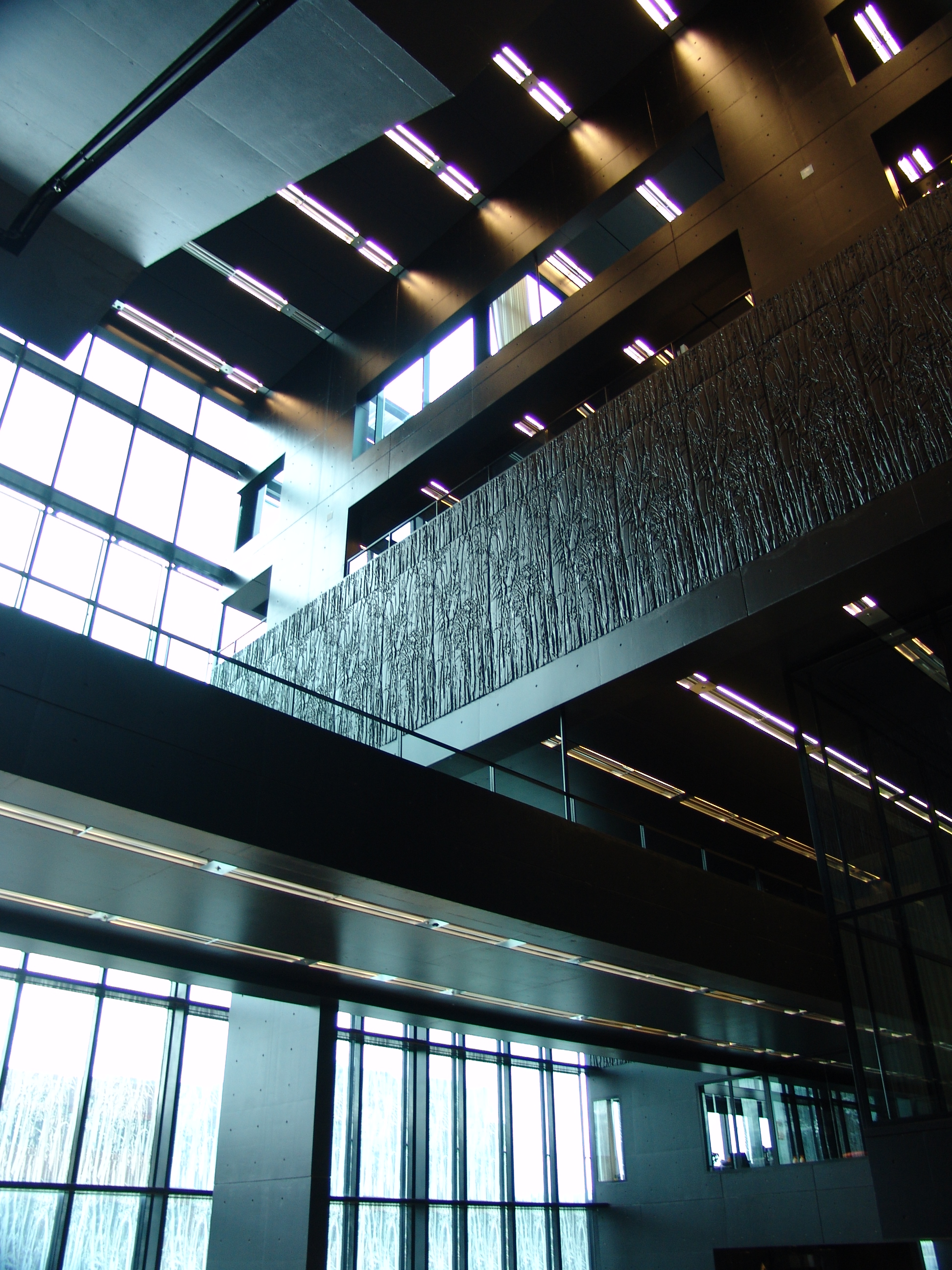
What I find really amazing though, is that Utrecht University also has very modern and strange architecture. The university campus, called the Uithof, is just outside of the city, about 20 minutes by bus from the city center. All the university buildings not in the city center are built there and they all look incredibly modern and amazing. The Educatorium, containing two enormous lecture halls, three examination rooms and the biggest cafeteria I have ever seen. It has a slope down for the cafeteria and one up for the lecture rooms. On the right side of the slope is glass so you can look outside, where there is also a slope and several geographical figures decorating the building.
 
 The library, containing more than four million books spread over several floors, looks very modern and is very comfortable to be in. It does not only contain legal texts, but it is shared instead with all departments. If you are anything like me and you regularly feel like branching your research, this library is a gift sent from heaven.


The Minnaert building has a fountain inside of it, which provides a green way of cooling the building. Also, how awesome is to have a fountain greet you between classes? This is a physics building though, so you probably will not spend much time in it. Not that the university minds if you peek inside. If you really get in trouble, say you are doing a case study on laws pertaining to construction provisions.


In short, Utrecht looks awesome. Even if you do not decide to study there, it is well worth it to visit it at least once in your life.

Tuesday, 29 May 2012

Techno geek FTW


In case you had not noticed, I am somewhat of a nerd. When I introduced myself, I already mentioned that I am always in front of a television or a computer (or both), which has made me very familiar with technical issues. The UU has a computer in every classroom that is attached to a beamer for presentations. It is built into a big box with confusing buttons. Confusing buttons always make me curious.

Unfortunately, it was not until my second year that I really got to play with them. I had a powerpoint and needed to handle the computer. The instruction pamphlet by the machine taught me the basics and the professor present, who was a bit of a geek herself, taught me the finer controls. It is nice to be able to help other students and even other professors when they are having trouble with it.

Anyway, I always carry my laptop with me to classes. This is firstly because I can type much faster than I can write by hand and secondly because digital notes can be distributed much more easily and can be shared online on my blog. Originally I just put them online with the idea of students coming along and discussing and correcting my work. Instead, it seems I am the go-to guy for skipping homework and finding the notes to classes people missed or skipped.

Most classrooms in the UU are fit perfectly for laptop use. Well, as long as there are only half a dozen laptop users. The buildings are pretty authentic and not build with an endless supply of electrical sockets. In fact, I often try to be the first one to enter a classroom so that I can make sure I am seated in one of the four of five seats that have the easiest time getting electricity. Lately I have been bringing an extension cord so that more laptops can be plugged in and I am guaranteed a worry-free class.

I have to say though, the technical assistance is amazing. There is standard documentation for most technical questions (like connecting to the protected wi-fi) and the few times I did have trouble, a quick e-mail to the IT crowd resolved the issues almost immediately. And Wi-fi coverage is extensive; I do not know of even one room in University buildings where I cannot connect easily to it.

Thursday, 24 May 2012

Using the research


Last week I talked about doing research for my thesis and what that meant. Obviously, the next step is putting that research to good use. Like doing the research, there are a couple of ways to present your findings that are pretty distinct. Here I focus on presenting the findings of research on relevant literature.

The first type is the most factual. You have found out some information, and you present it ordered by source. I did this with my bachelor thesis, talking about the desirability of minimum punishments[1]. I had collected articles of several prominent lawyers, summarized their opinions and arguments on the matter and presented them per writer. I called the chapter ‘views on authors on minimum punishments’ and started 9 out 10 paragraphs with the name of an author. Knigge wrote in 2000 about X. Duker agrees with Knigge on X1, but differs when it comes to X2.

The problem of course is that it reads very much as a summary and is not very useful for actual results. A better method is to use all the arguments and make your own framework. That is, use the substance of the views of the authors, without going into detail who said what. It is what I am trying to do as much as possible in my master thesis. It requires a lot of originality, which also means it is highly error-prone. Also, to make everything fit, it is very possible you will have to disregard some views. This happens mostly when different models have fundamental differences in their starting points.

This happens a lot in criminal law when it comes to the goals of punishments and penal law. Going back to minimum punishments, its desirability depends a lot on what you believe are the primary goals of punishment. When retribution is your mail goal, extra punishments are fully justified. When you actually care about the welfare of society and the criminal as a human being, more flexibility is desired.

A completely different alternative to present the findings is to simply look at one author and thoroughly explain their views, before applying it to another problem. I did this with a paper I wrote for Comparative Legal Cultures[2]. In it I used the model of Hofstede, who has tried to scientifically index facets of national cultures, to chart the acceptance of Same-sex marriage in Europe. The description of the model was far more in-depth than it would have been with the first method of presenting research, without all the risks of overlooking certain aspects that the second method has.

 Obviously, this all is just the tip of the iceberg, but hopefully it is at least a nice introduction. Now, I am off to stop procrastinating and work on my master thesis… after I finish walking the dog.


[1] Minimum punishments: under certain conditions, a judge is required to give the guilty suspect a minimum amount of punishment; my thesis was about a minimum amount of prison time for repeat offenders.
[2] I have been meaning to put this paper online, but it has  delayed due to the complexity of the format.

Monday, 21 May 2012

Law and science


There is a new field in the Dutch legal scene called ‘civilology’. In a notation of a recent case by the higher appeal court (Hoge Raad), Vranken wrote about this new version of civil law (NJ 2012,182-184). In the NJB (the Dutch Legal Journal), Hartlief describes this notation and he has a few questions.

The example given by Hartlief is of a truck that hit a child playing by a heap of sand. It drove forward a bit and then backed up, seriously wounding the child. The lower court ruled that the driver is not liable because he should not have needed to pay attention to the child; the driver could have reasonably thought that a child would stay far away from such a large and dangerous truck. The higher court disagreed and considered that children are highly unpredictable and that such a large truck would have attracted their attention.

Civilology would roll its eyes at both rulings, muttering ‘merely hypotheses’ before finding an actual answer using the results of empirical sciences. Looking through psychology and biology journals probably will not let you find an article written specifically to test the attractiveness of large trucks on children, but there will be articles with the most accurate information about children’s behavior. The limits mentioned by Hartlief include that those fields of study are not writing articles while thinking about the problems of civil law (they have different priorities), and that the civiloligist needs to be always wary of the quality and relevance of the science.

The questions being asked are whether this is a good thing. I will say, unapologetically, that this is possibly the best thing that has ever happened to the legal system since criminology. At the moment judges make an informed guess. How improved would their decisions be if they would actually based on, you know, that trivial thing called reality?

It reminds of a recent article in the Advocatenblad (Advocate’s Journal) where a lawyer wrote an article meant to scientifically discuss the effects of (prison) punishments. He described the criminology view (based on actual science) and then made up an alternative hypothesis on the spot, acting like he had thusly debunked the entire argument. This is of course not how the empirical debate works and it illustrates the reason why I often sigh and roll my eyes when the study of law is called a science.

There are a few ground rules. If you can use any evidence to prove your hypothesis, it is not science. If you can use your hypothesis to explain any evidence, it is not science. These are among the principles that really ought to be taught to anyone who cares about the truth. Imagining the answer is easy, actually finding it is hard. Civilology is a great step to getting where we should be.